Transitioning to retirement begins with sound financial planning. We're not trying to make you an expert — we want you to make a confident transition, so you can spend freely and live without regret.
Many standard retirement plans miss key insights, leaving your life savings to chance. Here's what most plans get wrong.
Most plans assume spending is constant throughout retirement — reality and research suggest otherwise. When you first retire, spending is high: trips, hobbies, dining out. As you age, you slow down and spend less. Eventually, healthcare costs rise while discretionary spending falls. A good plan accounts for all three phases.
A $1 million 401(k) isn't really $1 million — it's split between you and Uncle Sam, and Uncle Sam wants roughly 30%. Most plans treat taxes as fixed, but strategic tax planning can significantly reduce that burden and keep more money in your pocket over the course of retirement.
Most plans assume economic conditions are constant, but when you retire matters enormously. In 1984, $1 million could support $13,000 in monthly spending. In 1967, that same million only supported $8,000. We can't predict the future — but we can assess today's climate and plan accordingly.
Most plans assume bonds rise when stocks fall. That relationship has weakened — stocks and bonds have become increasingly correlated. A truly diversified plan must look beyond the traditional mix to protect against downturns when both move in the same direction.
We don't know when the next one is coming, or how big it will be — but we can be well prepared. This means designing a portfolio that can withstand turbulence early in retirement, when sequence of return risk is at its highest.
Cash is a great safety net, but holding too much of it is its own risk. Over time, inflation quietly reduces what your dollars can buy. The plan must balance liquidity with long-term purchasing power.
Which accounts you pull from — and when — affects your total tax liability, the longevity of your savings, and your ability to weather market volatility. Getting this right is one of the highest-impact decisions in retirement.
Our retirement transition process is built around a structured series of meetings — each one building on the last, moving you from where you are today to a confident retirement.
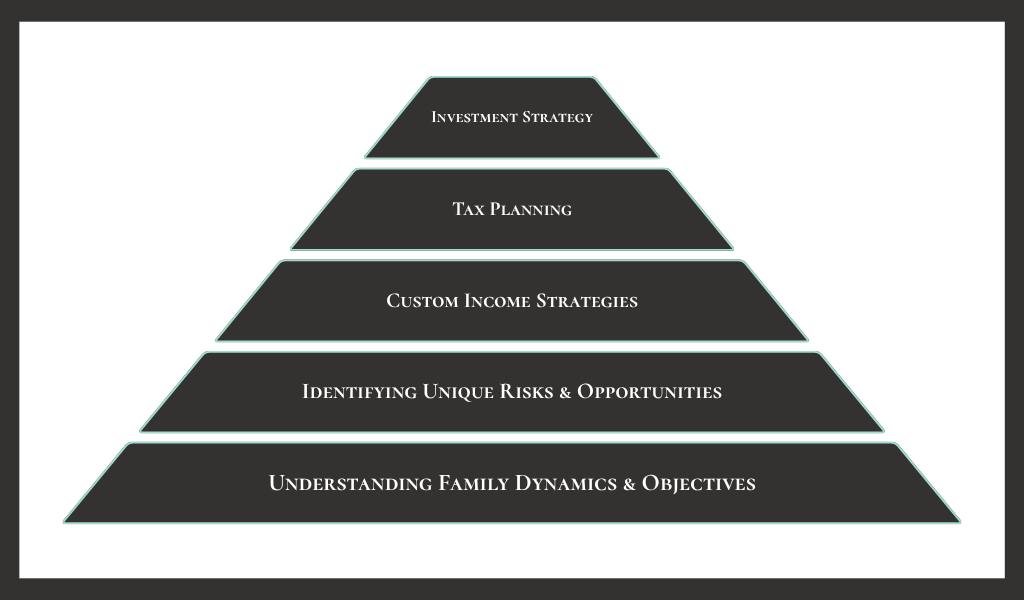
We'll ask a lot of questions to understand where you are today and what you want retirement to look like. The information gathered here serves as the foundation of your entire plan.
We'll walk you through a visual snapshot of your entire financial picture — all your financial instruments and how they work together. This ensures nothing is overlooked and gives us a shared understanding of your complete picture.
Don't be surprised if you have an "aha" moment when you see all the pieces come together.
This is where the plan comes to life. We answer the question: "Are we going to be ok?"
We'll walk through:
Up to this point, our projections have used average long-term market returns. But what if markets perform poorly in the first five years of your retirement?
We'll stress-test your plan against a significant early decline — and evaluate what that means for the longevity of your portfolio.
Now that you have a successful plan in place, we strengthen it. We align your portfolio with your goals, risk profile, and guaranteed income sources — and begin drafting an Investment Policy Statement.
If you have a pension, we'll analyze your payout options considering life expectancy, survivor benefits, and life insurance. We'll also begin the process of claiming your pension benefits.
Life has twists and turns. We'll analyze the impact of long-term care and healthcare events on the longevity of your portfolio and your legacy goals.
It doesn't need to be perfect — we'll refine this as retirement unfolds.
We've covered a lot. In this meeting, we step back and review:
Our goal is for you to transition confidently — not worried about spending or outliving your savings.
We'll explain what our ongoing relationship looks like and how we continue to add value after the initial planning phase. This is where we outline our service model and ensure we're aligned on expectations going forward.
Now for the fun part — accessing your money. We'll make sure you're comfortable navigating your accounts and moving funds from Charles Schwab to your bank account.
This is a crucial meeting shortly after retirement begins. We'll discuss:
Our goal is to make sure your transition from work to retirement is seamless.
No hidden charges, no commissions, no surprises. You'll always know exactly what you're paying and what you're getting.
A one-time flat fee, agreed upon and outlined in your client agreement before we begin. This covers the full 10-meeting retirement transition process.
Fees are negotiable and determined based on complexity.
| $0 – $500,000 | 1.15% |
| $500,001 – $1,000,000 | 0.85% |
| $1,000,000 – $2,000,000 | 0.75% |
| $2,000,000 + | 0.65% |
Example: A $1,000,000 portfolio = ~$10,000 annually (blended 1.0% rate).
Children of our clients are our clients. We believe a family that plans together builds more wealth together — so we've structured our fees to reflect that.
Investment management fees at Voyage are householded — meaning your children's accounts are grouped with yours when calculating your fee tier. As your combined family assets grow, everyone in the household moves to a lower rate together.
The more your family grows with us, the less everyone pays.
Your child's account benefits from your household rate — not a higher starting tier.
A focused analysis of the key financial elements that define success early in your career.
Best for professionals under 40 who are building their first financial plan.
Geared toward reducing taxes, optimizing investments, and planning for retirement.
Best for professionals over 40 who are actively building wealth.
We start with what matters most. Throughout the year, we help you manage your finances with precision.
For clients who want continuous, active guidance.
No pressure, no pitch. Just a clear path to understanding whether we're the right fit.
A 30-minute call to discuss what you're looking for, what it's like to work with Voyage, and any questions about our approach.
If it seems like a good fit, we'll recommend a complimentary "What Does Retirement Look Like?" meeting to clarify your goals and priorities.
Our first real meeting — focused entirely on you. Your vision of retirement, your challenges, and your starting point. This becomes the foundation of your plan.
Stay in touch. Get retirement transition insights delivered straight to your inbox.