Fiduciary Consultation Clients

Retirement Planning Insights

Practical insights for pre-retirees and retirees.

Financial Planning5 min read

Finding a Fee-Only Fiduciary in Mississippi

A fee-only fiduciary is a financial advisor paid only by clients, with no commissions or product sales. They're required to act in your best interest at all times. Fee-based and commission advisors are paid to sell you Life Insurance, Annuities, and high-expense mutual funds. While fee-based advisors may be great people, the firms they represent generally profit from more sales — whether or not those products are right for you. This article covers where to find a fee-only advisor, how to verify that an advisor is actually a fiduciary using free public records, and what to expect when you reach out. If you are still working out whether fee-only matters, start with our article on brokers versus fiduciaries.

Taxes in Retirement7 min read

Creating a Tax-Efficient Portfolio Before Retirement

Two people can hold the exact same investments and end up with two very different tax bills. The difference often isn't what they own. It's how they own it, and where. Every account type plays by its own tax rules. Taxable, tax-deferred, and Roth accounts each treat growth and income differently. Investment types carry their own tax rules too. Bonds, stocks, mutual funds, and ETFs don't all get taxed the same way, and even two funds holding the same basket of stocks can produce very different tax outcomes depending on how each one is structured. Understanding how these pieces fit together (what you hold, how you hold it, and where) can help you keep more of your portfolio working for future retirement income.

Retirement Income10 min read

6 Things Standard Retirement Plans Miss - Biloxi, MS

Retirement planning is a relatively new concept. The need for it grew as pensions gave way to other retirement accounts, shifting the responsibility from employers to employees. Retirement planning, as we know it today, has evolved. In the 1970s, most people invested through stockbrokers who earned commissions for selling stocks. In the 1980s and 1990s, mutual funds and insurance products took over, sold by people who are still very much around today. But true financial advice didn’t start to emerge until the early 2000s. As the internet made it easier to buy and sell stocks independently, advisors shifted from pure investment advice to retirement planning. With that evolution came advanced techniques to plan for retirement. As retirement plans broke amid the 2000 and 2008 drawdowns, alternate methods were disseminated, backtested, and vetted. The days of assuming flat linear returns, an average economy, and static spending habits are over.

Financial Planning6 min read

What Is a Retirement Plan?

A retirement plan is not a calculator, a set of projections, or a portfolio. It is a documented, actionable strategy for how income will be created, how taxes will be managed, and how wealth will transfer, built around your specific situation rather than a generic projection. Below, we break down what a retirement plan is not, what it actually is, and why retirees and pre-retirees across the Mississippi Gulf Coast work with a fee-only fiduciary to build one. A retirement plan is not a static document or a projection of your portfolio performance. It is easy to mistake one piece of the puzzle for the whole picture, and that mistake can be costly once you are actually living off your savings. Here are four things that often get confused with a retirement plan.

Taxes in Retirement13 min read

Tax Considerations Before Retirement: Tax Diversification

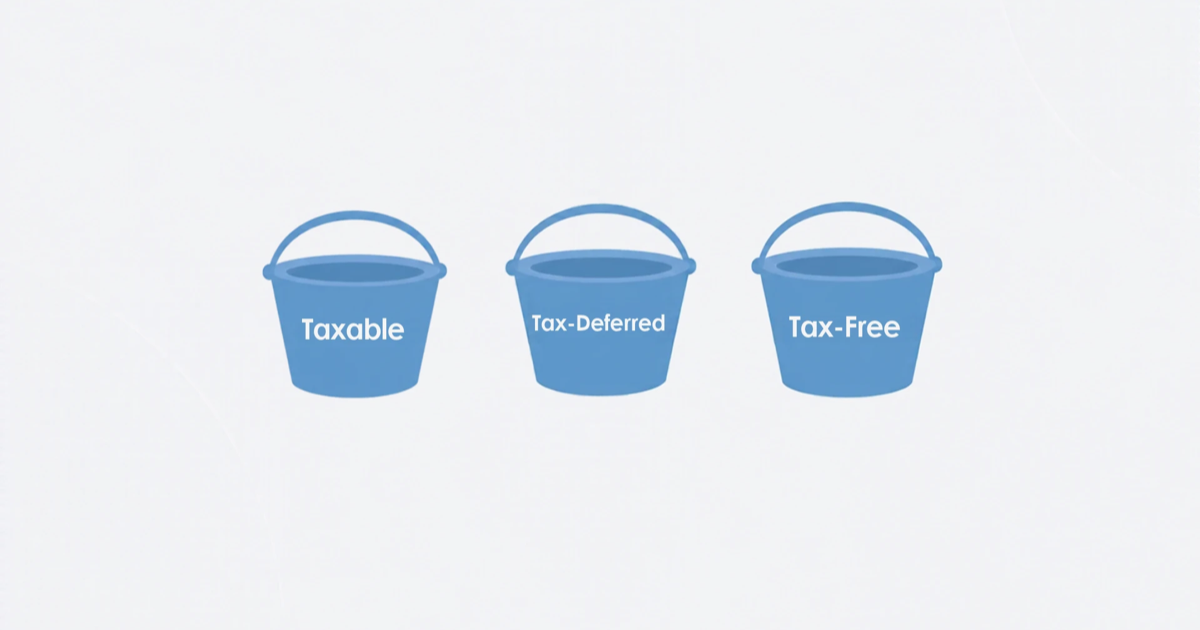
Tax diversification means spreading your retirement savings across accounts that are taxed in different ways. It's about giving yourself control over taxes in retirement, instead of the IRS. Most people have nearly everything in one place, usually a traditional 401(k) or IRA. That works while you are saving. But, it can cost you later, when every dollar you withdraw is taxed as ordinary income. Building savings across tax-deferred, tax-free, and taxable accounts gives you options. Tax diversification is when you hold money in different accounts with different tax treatments. Think of it as three buckets. The first bucket is tax-deferred. This is your traditional 401(k) or IRA. You get a deduction now, your money grows without annual taxes, and you pay ordinary income tax on every dollar you withdraw later.

Financial Planning7 min read

The True Cost of a 401(k) Loan

A 401(k) loan is one way to finance major purchases. For those nearing retirement, but not quite there, borrowing against your 401(k) assets is one way to tap into your benefits before you retire. Like many pre-retirees, you may be thinking about final home renovations, a second property, or a new toy. With your retirement benefits near an all-time high, and when mortgage and personal loan rates are high, a 401(k) loan can sound like a great option. A 401(k) loan is a provision allowing you to borrow up to 50% of your vested account balance. Typically, loans are capped at $50,000 of your 401(k) savings and must be repaid within 5 years (with an exception for loans used to purchase a primary residence, which may qualify for a longer repayment period).

Tax Planning10 min read

5 Retirement Tax Traps That Can Cost You Thousands

A lot of people assume their tax bill will shrink once they stop working. And in some cases, it does. But retirement also introduces a new set of tax rules that didn't apply during your career, and if you're not aware of them, they can add up fast. Withdrawals from retirement accounts, Social Security taxation, Medicare premium surcharges, and investment income taxes don't operate in isolation. They interact with each other in ways that can push your effective tax rate higher than you'd expect. The good news is that most of these traps are avoidable with proactive planning. Here are five of the most common ones. Many retirees assume their Social Security benefits are tax-free. They're not, at least not entirely. Depending on your income, up to 85% of your benefits may be subject to federal income tax.

Taxes in Retirement12 min read

Managing Taxes in Retirement

Managing taxes in retirement can be more complicated than during your working years, when your employer typically withholds payroll taxes throughout the year. It's not uncommon for retirees to have multiple sources of income: Social Security, pension, Traditional and Roth IRAs, rental income, and taxable investment accounts. Each has unique rules and tax consequences. Vanguard research estimates that tax-efficient withdrawal strategies and other planning techniques may add up to approximately 3% in net value over time, depending on your circumstances. The actual amount of value added may vary significantly depending on clients' circumstances. "Up to, or even exceed 3%" means 3 percentage points of additional net return over an unspecified period of time. The value-add estimate referenced above is based on research and modeling assumptions by Vanguard and is not a guarantee of investment performance. Actual outcomes will vary depending on individual circumstances and market conditions.

Financial Planning7 min read

Fiduciary Financial Advisor in Biloxi Mississippi

Most investors assume that anyone providing financial advice is legally required to act in their best interest. That assumption is understandable, but often incorrect. In the United States, financial professionals are compensated under three basic models: fee-only, fee-based, and commission. A fee-only fiduciary financial advisor is paid solely by the client, with no commissions or product sales involved. A fee-based advisor charges a fee but can also earn commissions on certain products. A commission-based advisor, often called a broker, is paid primarily when a product is sold. Only the fee-only model removes outside compensation entirely, which is why it carries the fewest built-in conflicts of interest.

Market & Investing8 min read

More Than a Score: The Two Sides of Investment Risk

When most people think about investment risk, they ask themselves one question: Can I stomach the ups and downs? It's a reasonable place to start. But it's only half the picture. Relying on it alone can derail an otherwise well-built retirement plan. There are two distinct dimensions to investment risk: your willingness to take it, and your capacity to take it. They sound similar. They are not the same. And when they're misaligned (which happens more often than you'd expect), the consequences can follow a retiree for years. Most investors have filled out a risk questionnaire at some point. You answer a series of questions about how you'd feel if your portfolio dropped 20%. You pick words like aggressive, moderate, or conservative. You get a numbers-based score, and the advisor assigns you a portfolio.

Retirement Income10 min read

When Market Declines Hurt the Most

You've worked for decades. You've saved diligently, contributed to your 401(k), and maybe even worked with an advisor. By most measures, you've done the right things. Then retirement arrives, and the market drops. That's one of the biggest fears pre-retirees live with as they transition to retirement. It's also one of the most consequential risks in retirement planning, and it has a name: sequence of returns risk. Sequence of returns risk refers to the timing of investment losses, not just their size. A market decline early in retirement, if you're not prepared, can significantly derail your retirement plan. Most retirement plans focus on how much you've saved and what your portfolio might average over time. But averages can be misleading. A portfolio that averages 7% annually over 30 years doesn't earn 7% every single year. Some years are up 20%. Some are down 30%. And in retirement, the order of those up and down years matters enormously.

Page 1 of 2
Disclosures

Voyage Wealth Management, LLC, is an investment adviser registered with the state of Mississippi. This content is provided for informational purposes only and should not be relied upon in any manner as professional advice, or an endorsement of any practices, products or services. There can be no guarantees or assurances that the views expressed here will be applicable for any particular circumstances, and should not be relied upon in any manner. You should consult your own advisers as to legal, business, tax, and other related matters concerning any investment.

References to any securities or performance data are for illustrative purposes only and do not constitute an investment recommendation or offer to provide investment advisory services. Charts and graphs provided within are for informational purposes solely and should not be relied upon when making any investment decision. Past performance is not indicative of future results. Investments in securities involve the risk of loss. The content speaks only as of the date indicated. Any projections, estimates, forecasts, or opinions expressed in these materials are subject to change without notice and may differ or be contrary to opinions expressed by others.