
Two people can hold the exact same investments and end up with two very different tax bills. The difference often isn't what they own. It's how they own it, and where.
Every account type plays by its own tax rules. Taxable, tax-deferred, and Roth accounts each treat growth and income differently. Investment types carry their own tax rules too. Bonds, stocks, mutual funds, and ETFs don't all get taxed the same way, and even two funds holding the same basket of stocks can produce very different tax outcomes depending on how each one is structured.
Understanding how these pieces fit together (what you hold, how you hold it, and where) can help you keep more of your portfolio working for future retirement income.
Investment Selection
Mutual Funds are Tax-Inefficient in Non-IRA accounts.
When a mutual fund manager sells underlying securities for a profit, the fund passes that tax liability onto you as a capital gains distribution. This triggers an annual tax bill, even if you reinvest the distribution and your account balance is down. Actively managed mutual funds frequently buy and sell stocks (hence the active management), creating more taxable events.
Mutual fund distributions are taxable in standard accounts during the year they are issued. They are primarily categorized as either Ordinary Dividends (taxed as ordinary income) or Qualified Dividends (taxed at lower long-term capital gains rates).
If you're holding mutual funds in an IRA, the tax-deferred nature of the account shields you from taxes on capital gain distributions and dividends.
Before you decide to add a Mutual Fund holding, the first question to ask isn't tax efficiency; it's whether the costs justify the returns compared to a passive alternative. Many fund options can be eliminated based on performance.
ETFs are More Tax-Efficient than Mutual Funds
Most ETFs use a structure that helps investors avoid surprise tax bills. When you sell ETF shares, you're trading with another investor on an exchange. The fund itself doesn't need to sell anything to hand you your money.
Mutual funds work differently. When enough shareholders redeem, the fund manager may need to sell holdings to raise cash. Those sales can create a capital gains distribution for every shareholder in the fund, even the ones who never sold a share.
ETFs use a process called in-kind redemption. Instead of selling securities for cash, the fund can hand off appreciated shares directly to a market maker. This step lets many ETFs sidestep capital gains at the fund level.
The result is more control for you. You generally owe capital gains tax when YOU decide to sell, not because another shareholder decided to cash out. ETFs can still pay taxable dividends and interest each year, so they aren't tax-free. But for most investors, they can be a more tax-efficient building block than an actively managed mutual fund in a taxable account.
Municipal Bonds Benefit Higher Tax Brackets
Municipal Bonds are loans you make to a state, city, or local government. They use the money to build schools, roads, or water systems. In return, they pay you regular interest and give back your money later. Their fixed-income nature makes them safer than equity investments in retirement.
The interest from a Municipal Bond is often free from federal taxes, unlike Treasury and Corporate Bonds, which are both taxed as income at the federal level. The yields, however, can be lower compared to corporate bonds. Corporate bonds come with more risk; therefore, investors require a higher return. But with tax-free income from municipal bonds, lower yields can still look more attractive on an after-tax basis compared to corporate bonds.
Corporate bonds and municipal bonds should be evaluated based on which has the highest after-tax yield. The tax-equivalent yield (TEY) can measure this. TEY is the pre-tax return that a corporate bond must earn to match the after-tax return of a municipal bond. If the TEY is higher than what a corporate bond is paying, municipal bonds would provide a higher after-tax yield.
Tax-Equivalent Yield Calculator
Enter a municipal bond yield and your federal tax bracket to see the yield a taxable bond would need to match it, after tax.
This calculator is a self-help tool for illustration only. It does not account for state taxes, the Alternative Minimum Tax, or your individual circumstances, and it is not a recommendation to buy or sell any security.
Direct Indexing vs. ETFs
What is direct indexing?
Direct indexing is a strategy for taxable accounts where you buy the individual stocks that make up an index, like the S&P 500. Instead of owning baskets of stocks through an ETF, direct indexing allows you to own each stock in the index.
Owning the stocks individually opens up tax loss harvesting opportunities that an ETF can't offer. With direct indexing, you can sell a stock that's down, even while the index overall is up. You can use that loss to help offset gains elsewhere in your portfolio. Excluding specific stocks or sectors can be useful if employer stock already makes up a large piece of your net worth, or if you want to avoid a particular industry.
One ETF Position
A single holding that tracks an index.
The Underlying Stocks
The same index, owned as individual positions.
Front-End Benefits vs. Long-Term Complexity
The first year or two of a direct indexing account tends to offer the richest tax loss harvesting opportunities. New positions carry little built-in gain, so there's more room to sell a losing stock. But, over time, all ships rise with the tide.
The opportunity to harvest tax losses shrinks as the market rises. The more your individual stocks gain in value, the harder it becomes to sell one without realizing a gain. Rebalancing the account to keep it in line with the index tends to get more complex over time.
Direct indexing also requires more oversight. You must track hundreds (if not thousands) of individual tax lots instead of a few from a single ETF position. Pinpointing individual tax lots to sell at a loss while maintaining a proper asset allocation is time consuming.
Where Step-up in Basis Helps
When you leave appreciated investments to your heirs, they typically receive a step-up in basis. Their cost basis resets to the investment's value on your date of death. That step-up can eliminate the capital gains tax on the growth that happened while you held the investment.
This consideration matters more for a direct indexing account than for a single ETF. Because you own many individual stocks with different purchase dates and cost bases, each position gets its own step-up. For a long-held account with significant embedded gains, that can meaningfully reduce the tax bill your beneficiaries would otherwise face.
It's not about what you hold. It's about WHERE you hold it.
There are tax implications at the account level and at the investment level. Some account types are more tax efficient than others. Some investment options are more tax efficient than others.
Think of your accounts like the different storage spots in your kitchen. Ice cream goes in the freezer. Canned goods go in the pantry. Food in the wrong spot spoils faster. Your accounts work the same way. A taxable account, an IRA, and a Roth all hold investments, but each one treats growth and dividends differently. Put the same investment in the wrong account, and it can cost you more in taxes than it needed to.
The general logic goes like this:
- Tax-inefficient assets that generate ordinary income, like bonds and REITs, often fit in tax-deferred accounts, where that income is not taxed as it is earned. And you're paying income tax anyway when you withdraw.
- High-growth assets you expect to appreciate the most fit in a Roth, where growth generally comes out tax-free (provided holding-period and age requirements are met) and there are no lifetime RMDs.
- Tax-efficient assets like broad index ETFs and buy and hold stocks work well in taxable accounts. They generate little unwanted income, you control when gains are realized, and they receive a step-up in basis at death.
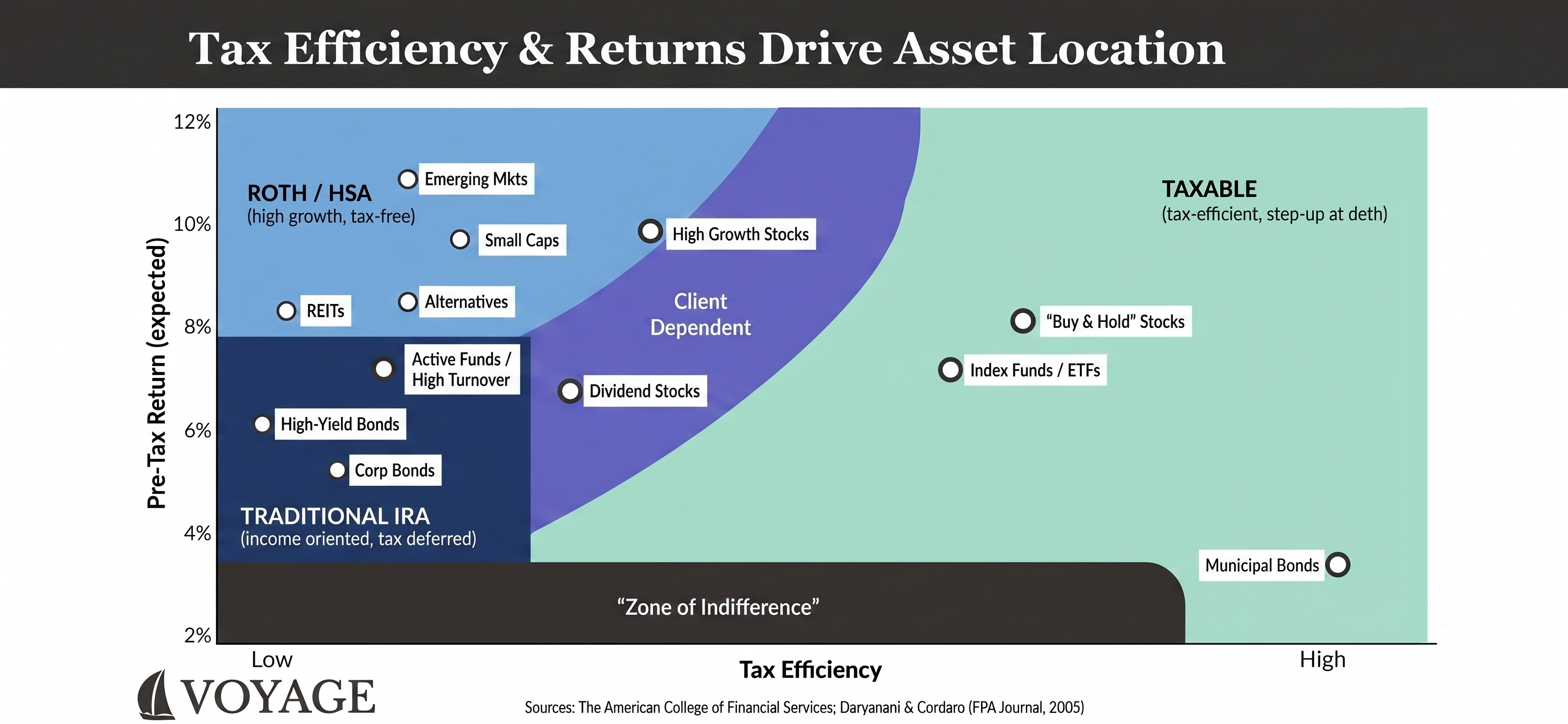
Asset location is one of the few places you may be able to improve an after-tax outcome without taking more risk or making major asset allocation changes.
What This Adds Up To
The after-tax performance of your retirement portfolio is what funds your retirement lifestyle. Reducing tax drag keeps more money in your account(s) for future years, and can help your tax bill for current years.
If you want to learn more about maximizing the after-tax returns on your investment portfolio, you can download the book: 21 Secrets to Future-Proof Your Retirement Income.
A practical guide to help you rethink the standard retirement industry advice, and create reliable income for life.
- ✓ The most effective way to create lasting income in retirement
- ✓ Take the guesswork out of assessing the markets and economy
- ✓ Keep taxes within your control
- ✓ Create an investment portfolio for long-term income and tax efficiency
- ✓ Navigate the “What Ifs” with clarity
Information and interactive calculators are made available to you as self-help tools for your independent use and are not intended to provide investment advice. We cannot and do not guarantee their applicability or accuracy in regard to your individual circumstances.
This content is for educational purposes only and should not be relied upon in any manner as professional advice or an endorsement of any practices, products, or services. You should consult your own advisers as to legal, business, tax, and other related matters concerning any investment. Past performance is not indicative of future results. Investments in securities involve the risk of loss. Please see disclosures here: https://voyage-wm.com/disclosures