
Retirement planning is a relatively new concept. The need for it grew as pensions gave way to other retirement accounts, shifting the responsibility from employers to employees.
Retirement planning, as we know it today, has evolved. In the 1970s, most people invested through stockbrokers who earned commissions for selling stocks. In the 1980s and 1990s, mutual funds and insurance products took over, sold by people who are still very much around today. But true financial advice didn’t start to emerge until the early 2000s. As the internet made it easier to buy and sell stocks independently, advisors shifted from pure investment advice to retirement planning.
With that evolution came advanced techniques to plan for retirement. As retirement plans broke amid the 2000 and 2008 drawdowns, alternate methods were disseminated, backtested, and vetted. The days of assuming flat linear returns, an average economy, and static spending habits are over.
Here are six things standard retirement plans miss, and what to consider instead.
1. Income Plan > Investment Portfolio
Your retirement income plan is far more important than your investment portfolio. It tells you how much you can spend each year, from which accounts, and the tax implications.
You may have heard of the 4% rule, which suggests withdrawing 4% of your portfolio in year one and adjusting for inflation after that. That’s better than nothing, but it misses taxes, Social Security timing, healthcare costs, and the fact that your spending will evolve through retirement. On top of that, studies show the 4% rule might be too safe [1].
A more complete income plan considers:
- How much you can spend each year, and from which accounts
- The tax owed on those withdrawals, and how that might change in the future
- Social Security timing for you and (if you are married) your spouse
- Inflation, healthcare costs, and life expectancy
- Contingencies, and how the plan could change under unknown circumstances
Your investment portfolio is the engine that keeps your checking account full. How you invest it depends on:
- Monthly income needs (and for how long)
- Tax Obligations
- Future Healthcare Needs
- Lifetime Income (Pensions & Social Security) and when benefits start
- Required Minimum Distributions
- To name a few…
Which are all identified and accounted for in your retirement income plan.
Your income plan precedes your investment portfolio. That’s critical to understand. Without an income plan, you’re flying blind with your investment decisions.
2. The Economy You Retire Into Matters
The standard retirement plan assumes average market returns and an average economy throughout retirement. Both can be anything but average, year to year. The market will have good years, bad years, and everything in between.
When you shift from saving for retirement to spending in retirement, the math of portfolio returns transforms. Higher returns benefit both savers and spenders. But the consequence of weaker periods disproportionately hurts the spender.
While you’re saving for retirement, you get to benefit from dollar‑cost averaging. This is where volatility becomes your friend. The same dollar amount buys more shares in down markets, thereby boosting long-term returns.
But once withdrawals begin, that same volatility becomes a threat. Your losses compound. The additional shares sold to provide income during down markets can never be repurchased. Moreover, the strong years that follow are less impactful, because the market is lifting your portfolio with fewer shares.
It’s important to assess the economy as you move into retirement. Unfortunately, this is also where many go wrong. The news and financial media are the loudest voices, and often the first you hear. They’re also paid to keep your attention. And they do that by instilling fear, anger, and emotions. A true economic assessment is unfazed by news and media. It looks at data and facts.
It’s important to stress test different market environments. An economic assessment is only as good as the information known today. The future is unknown. You couldn’t predict a pandemic in 2019. And sure, a few predicted the 2008 crash, but nobody knew how long it would last, or how bad it would get. Stress testing helps you visualize the possibility of outcomes under different market environments - which helps you make decisions you’re comfortable with.
3. Taxes Change in Retirement
If you retire with $2 million in a 401(k), you do not have $2 million. That balance is split between you and the IRS. Uncle Sam’s cut changes as the tax code changes.
The chart below shows how average effective tax rates have changed by income group. Rates for the top 1% have remained largely unchanged (besides briefly dipping below 30% in the 1980s). But rates for middle-class Americans have lowered over the years. [2]
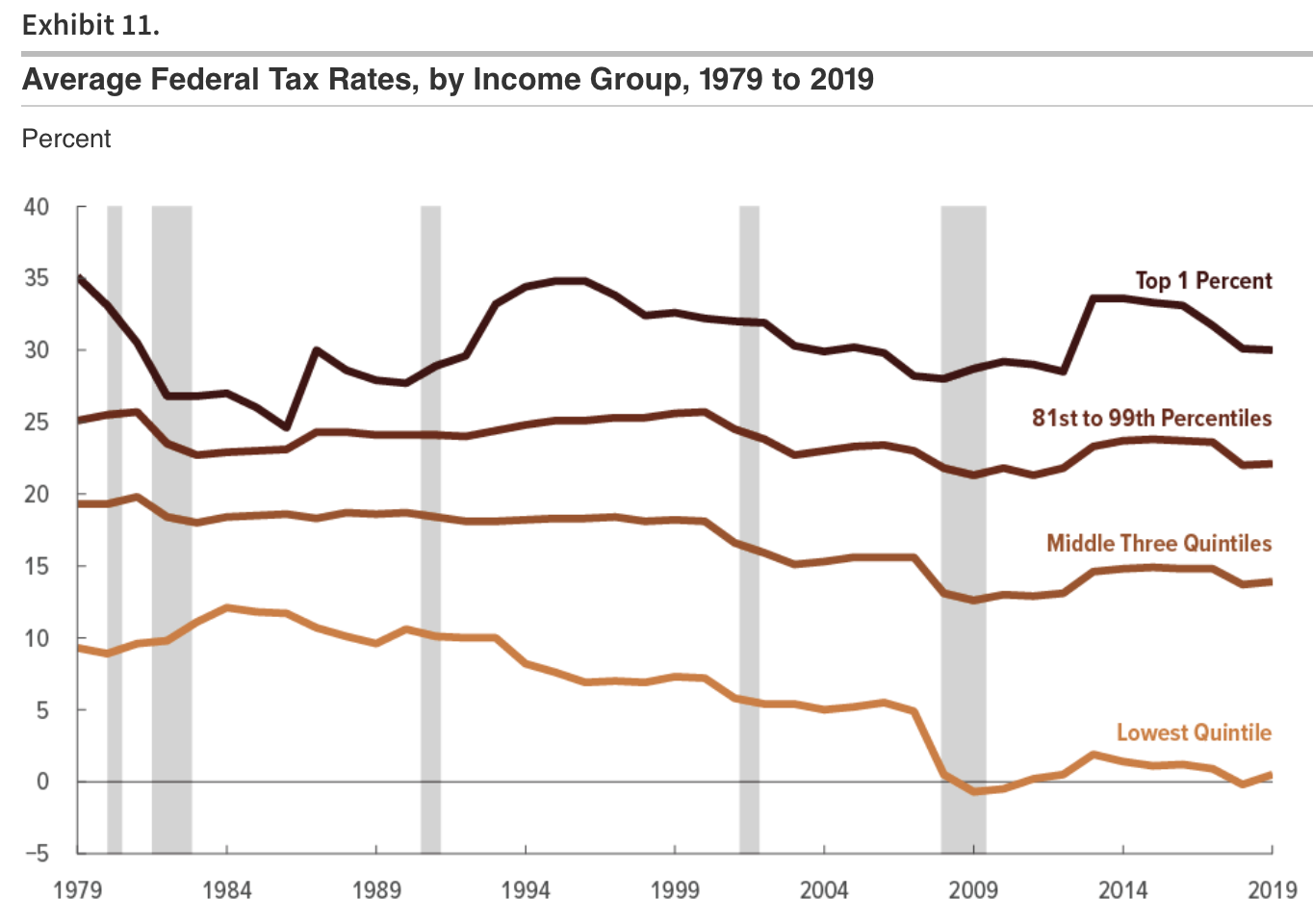
Source: Congressional Budget Office, 2019. The Distribution of Household Income.
Whether this continues depends on fiscal policy, including whether budget deficits widen and the national debt keeps rising. In my view, as deficits grow and debt climbs, the government will look for new ways to raise revenue. One possible avenue is income tax. Either way, it is safe to assume the taxes you pay at the start of retirement will not be the taxes you pay at the end.
Tax diversification puts you in control. Say you split your savings across three buckets instead (Tax-Deferred, Taxable, Roth). You have options no matter where income tax rates go. You can:
- Spend tax-free dollars from the Roth bucket
- Spend from the brokerage and pay the more favorable capital gains rate
- And only spend from the 401(k) to fill lower tax brackets
Building wealth for retirement isn't just about hitting a number. It's about controlling what you keep after taxes. That's the number that actually pays for your retirement.
4. Length of Your Retirement Varies
How long retirement lasts depends on when you retire and when you pass away. If the primary goal for retirement planning is to provide income for life, it would be helpful to know exactly how long you are going to live - which is unknown. But this is a critical factor, because the longer you live, the more future income you must supply. Conversely, the shorter you live, the more you can safely live on in retirement.
The standard retirement plan assumes that retirement ends at a specific age, typically between 92 and 95. Over the years I’ve watched people baulk at that age. Whether due to personal health circumstances or family health history, many believe they won’t make it that long. And rightfully so… The average life expectancy for a 65 year old is 83 (for men) and 85 (for women), according to the Social Security Administration.
Retirement planners use the age 95 life expectancy assumption as a safe route. If your plan lasts through age 95, it’s safe to assume you won’t run out of money - knowing that most retirees won’t live that long.
The difference between the standard life expectancy assumption (92 - 95) and Social Security averages is thousands (if not hundreds of thousands) in potentially unspent or overspent income. Social Security claiming strategies change too. A shorter life expectancy justifies claiming early or at Full Retirement Age, and vice versa. Significant life expectancy differences between spouses also warrant special planning considerations when claiming pension benefits, planning tax-smart withdrawals, and taking income year to year.
So, how do you put an age on life expectancy? While it sounds like an impossible task, life insurance companies have been remarkably accurate at this. When you apply for life insurance, you’re divulging your health data to the insurance company. The company uses that data alongside actuarial assumptions to predict your mortality age. Which ultimately determines the price for your monthly premiums.
We can apply that same math to retirement, using health factors such as the following to predict how long retirement will last:
- Family health history
- Personal health history
- Smoking status
- Frequency of doctor visits
- To name a few…
It’s not a fun exercise, by any means. But, done successfully, it could mean living on more while you’re healthy, or spending less to preserve income past age 100. Paired with scenario analysis, which I cover in #6, you get a realistic income plan that compares multiple life expectancies. That perspective helps you determine when to claim Social Security, which pension benefit to take, and how much you can safely live on through retirement.
5. Spending is Not Static in Retirement
The standard retirement plan assumes your spending habits remain the same through retirement. The number you live on at 65 is the same (but adjusted for inflation) at 95. Reality is further from that assumption.
According to the Financial Planning Journal, retiree expenditures tend to decrease both upon and during retirement. Actual retiree spending tends to decline approx. 1% per year during retirement, while healthcare expenses increase at the end of retirement. [3]
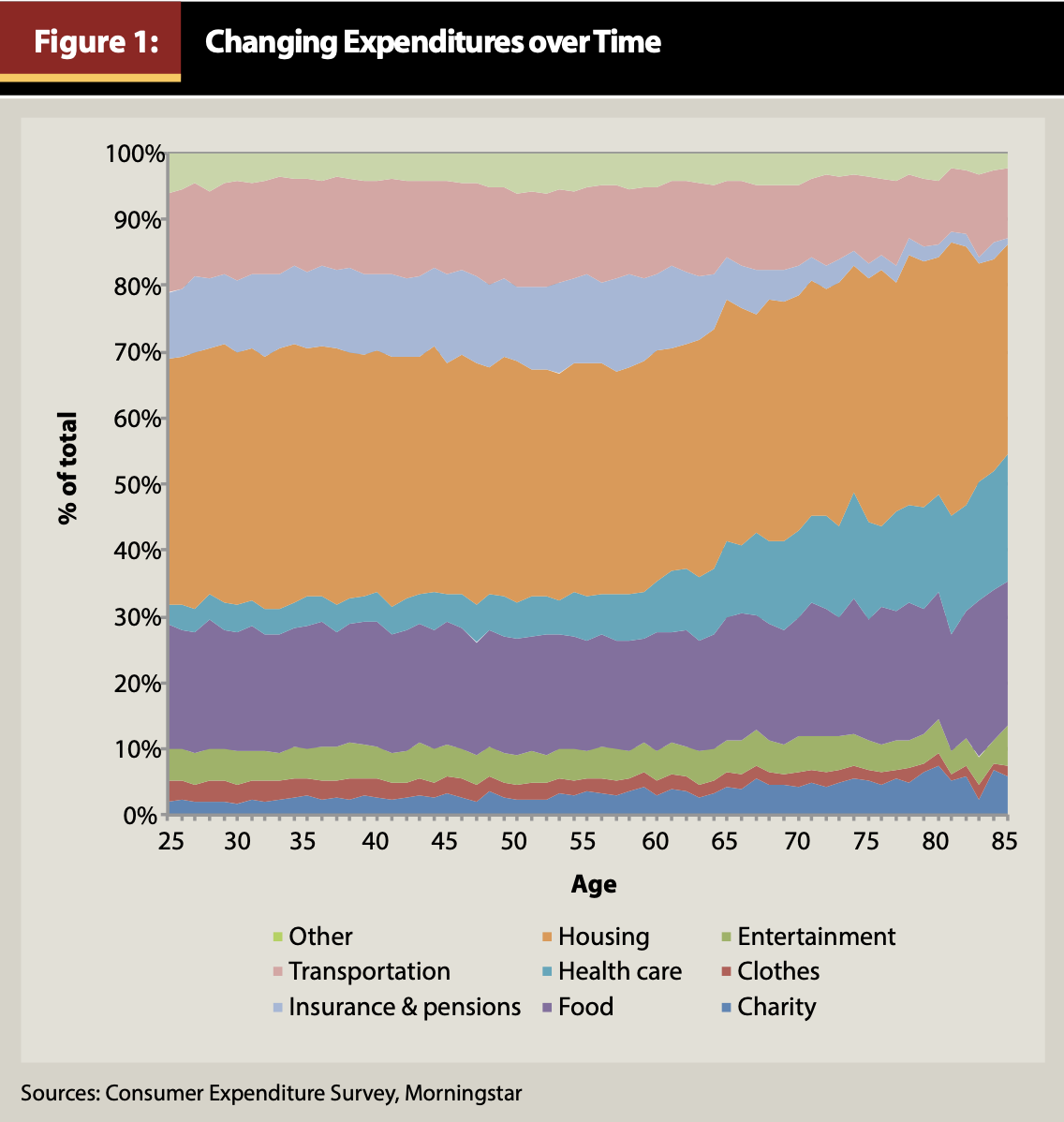
Source: Blanchett, David. "Exploring the Retirement Consumption Puzzle." Journal of Financial Planning, 2014.
- Work-related expenses decrease: commute, lunch, office clothes.
- Housing costs decline: mortgage gets paid off, property tax reduction for age 65+ homeowners in Mississippi. [4]
- Discretionary spending changes: traveling and dining out less as pace of life slows.
- Smaller households: children move out, sometimes a spouse passes away, reducing total household needs.
If your income needs change, your spending plan should change too, and the portfolio supporting that income should match. A portfolio built around flat spending assumptions may not align with the risk and return profile you need to retire successfully.
Similarly, your safe withdrawal rate early in retirement hinges on anticipated spending later in retirement. An income plan that assumes lower spending later in retirement may warrant higher spending early in retirement, when you can enjoy the money the most!
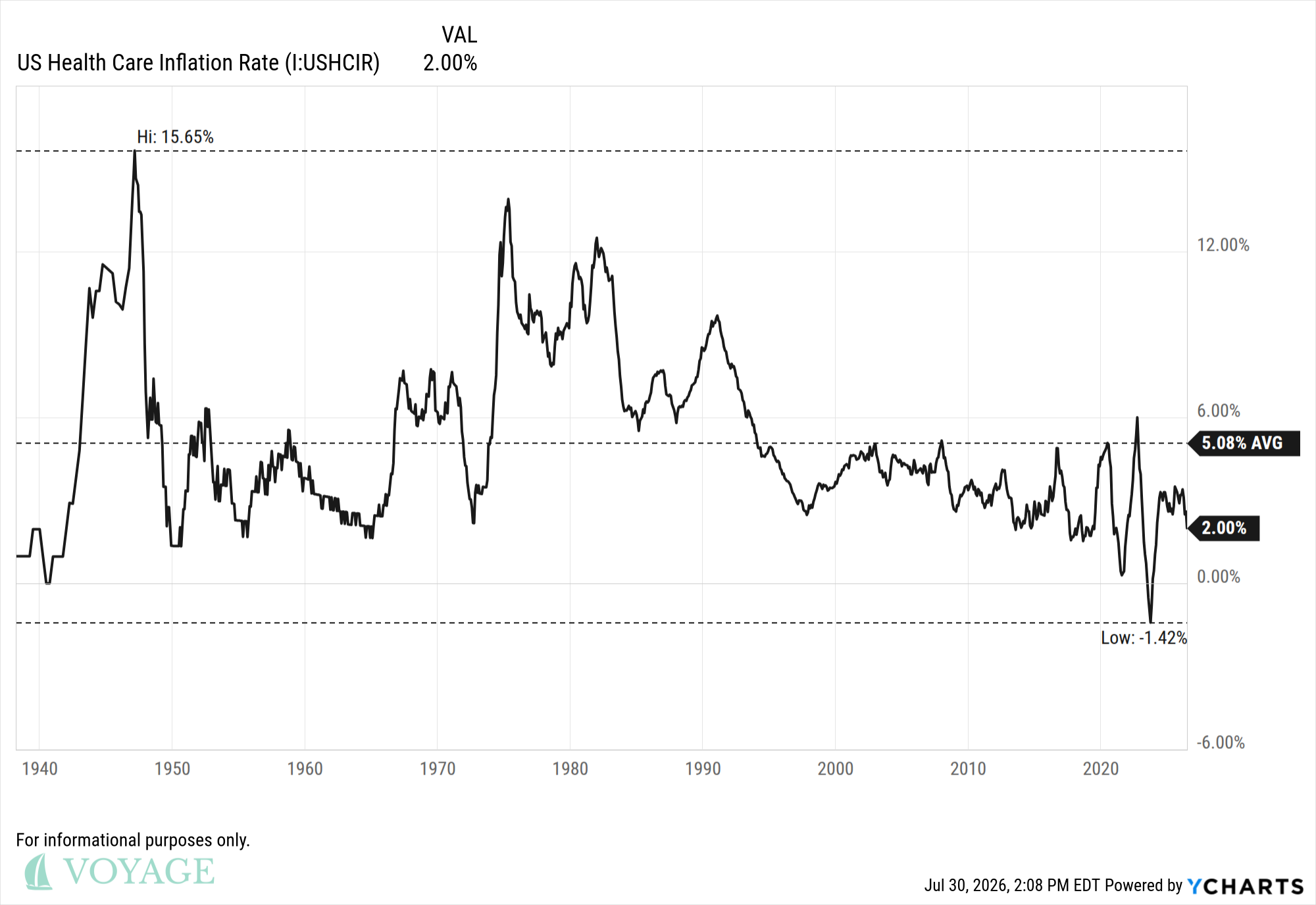
But beware of rising healthcare costs! Although healthcare inflation receded to ~2% in recent years, average inflation lies around 5%. Actual healthcare events tend to rise later in retirement. And Long Term Care can easily cost six figures a year, lasting several years. Your income plan must account for uninsured medical costs later in retirement.
6. Manage the “What-If’s” With Math
Handling what might come in the future is gut-wrenching. And we’ve already established that the media can add more uncertainty by throwing irrelevant nonsense at you. So the question is, how do you handle the “what ifs”?
Probability analysis is a method that runs thousands of randomized scenarios to see if your savings will last your lifetime. It tests your plan against unpredictable changes in market returns, taxes, Social Security, inflation, health care expenses, and life expectancies. The result is a success score between 0% and 100%. While the number is insightful, it’s the areas driving the number that you should plan around.
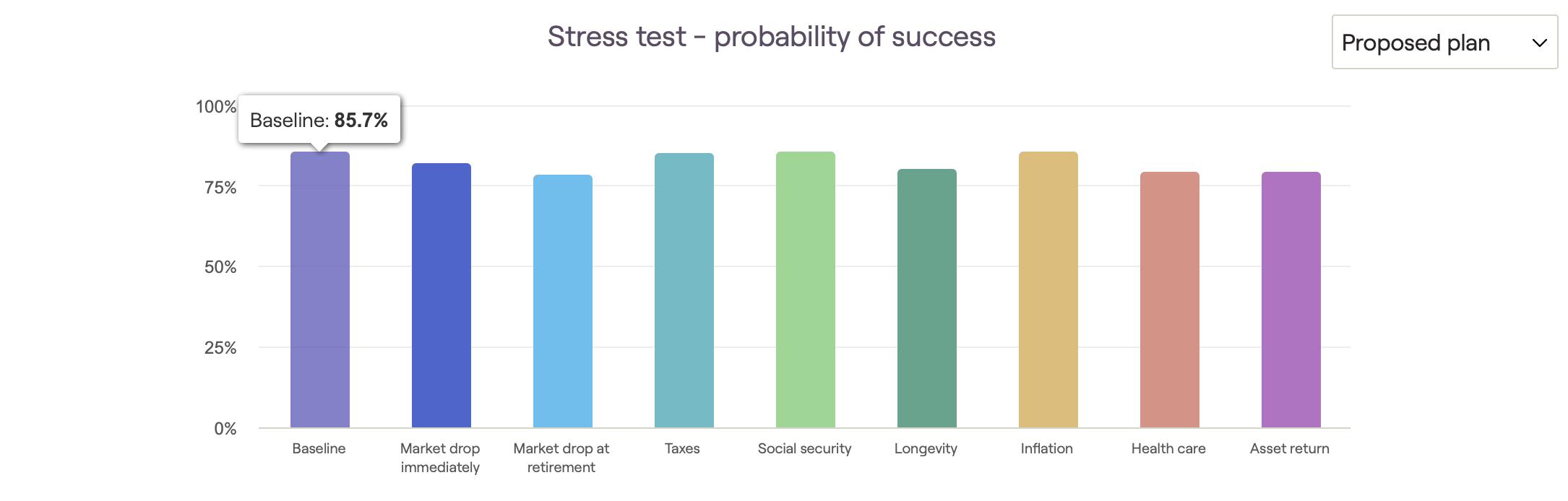
Scenario analysis. Probability analysis shows how often the plan works. Scenario analysis asks what happens if one specific thing occurs. What if the market drops 30% in my first two years? What if I live to 97? What if we went to Europe every summer? You break one variable on purpose and watch what happens. Now you can start to strategize around it!
What This Adds Up To
Standard advice is built for the masses. Take Social Security at 70, withdraw 4%, spend taxable accounts first. It is not for anyone in particular, which means it is not specifically for you.
It also tends to leave people with more questions than answers. And when you retire with more questions than answers, you spend retirement worrying. Leading to underspending and regret.
If you want to learn more about assessing the economy and creating a retirement income plan, you can download the book: 21 Secrets to Future-Proof Your Retirement Income.
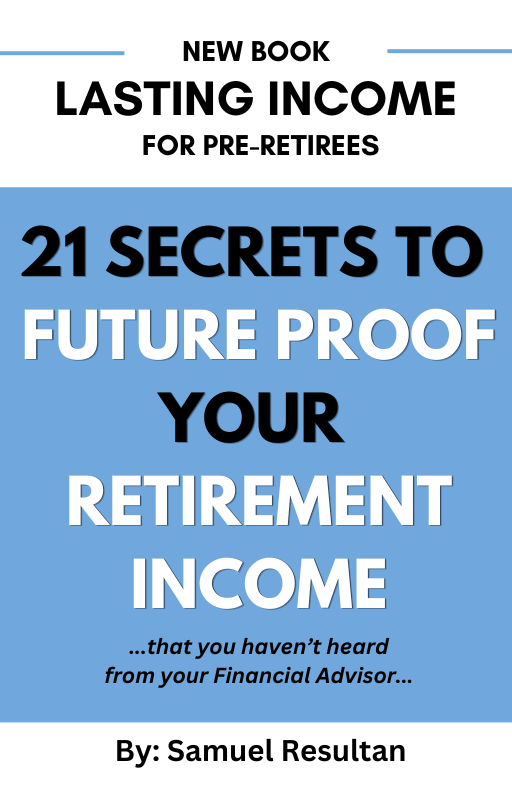
A practical guide to help you rethink the standard retirement industry advice, and create reliable income for life.
- ✓ The most effective way to create lasting income in retirement
- ✓ Take the guesswork out of assessing the markets and economy
- ✓ Keep taxes within your control
- ✓ Create an investment portfolio for long-term income and tax efficiency
- ✓ Navigate the “What Ifs” with clarity
- Kitces, Michael. "What Returns Are Safe Withdrawal Rates REALLY Based Upon?" Kitces.com. kitces.com/blog/what-returns-are-safe-withdrawal-rates-really-based-upon
- Congressional Budget Office. "The Distribution of Household Income, 2019." cbo.gov/publication/58781
- Blanchett, David. "Exploring the Retirement Consumption Puzzle." Journal of Financial Planning 27, no. 5 (2014): 34–42. financialplanningassociation.org
- Mississippi Department of Revenue. "Homestead Exemption." dor.ms.gov/county-services/homestead-exemption
This content is for educational purposes only and should not be relied upon in any manner as professional advice or an endorsement of any practices, products, or services. You should consult your own advisers as to legal, business, tax, and other related matters concerning any investment. Past performance is not indicative of future results. Investments in securities involve the risk of loss. Please see disclosures here: https://voyage-wm.com/disclosures